What are Virtual Clusters
Virtual clustersTenant clusterA certified Kubernetes distribution that runs as an isolated environment with a virtualized control plane hosted on a control plane cluster. Tenant clusters operate as independent Kubernetes environments, each with its own API server, control plane, syncer, and set of resources. are certified Kubernetes distributions that run as isolated, virtual environments nested inside a physical host clusterControl plane clusterThe Kubernetes cluster that hosts the virtualized control planes for tenant clusters. The control plane cluster is operated by the platform provider and is completely invisible to tenants. There are no shared control plane nodes, no in-cluster agent pods, and no lateral path between tenant environments. With shared nodes, this cluster also runs tenant workloads alongside the control plane pods — the same node pool is used for both.. They improve isolation and flexibility for tenant isolationTenant IsolationThe capability to host multiple separate users, teams, or workloads on the same infrastructure while providing strong isolation between them. vCluster delivers tenant isolation through dedicated control planes, isolated resource namespaces, and optional private nodes per tenant. by allowing multiple teams to operate independently on the same infrastructure, minimizing conflicts, increasing autonomy, and reducing costs.
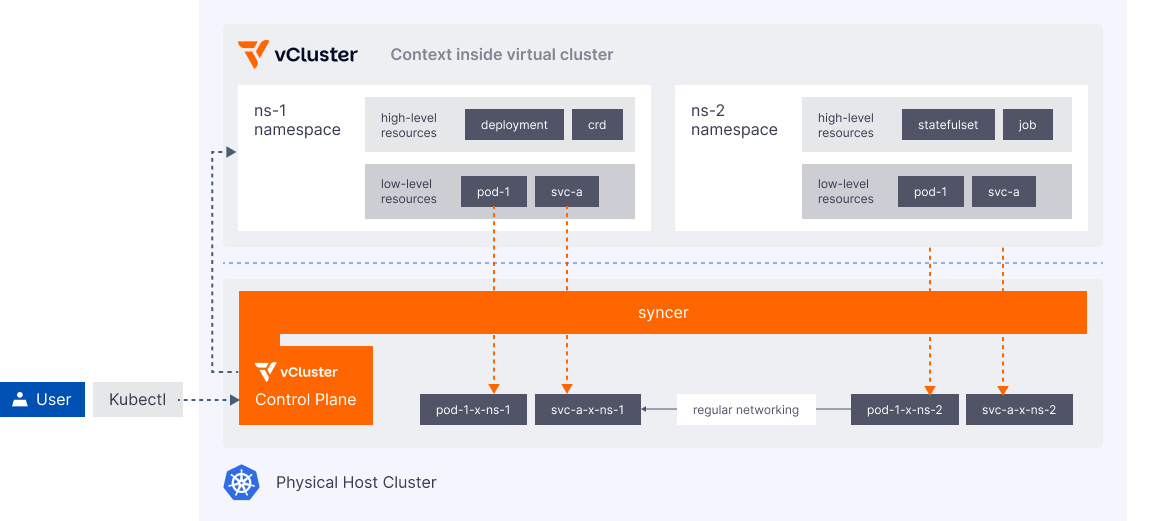
Virtual clusters run inside host cluster namespaces but operate as independent Kubernetes environments, each with its own API server, control plane, syncerSyncerA component in vCluster that synchronizes resources between the tenant cluster and the control plane cluster, enabling tenant clusters to function while maintaining isolation., and set of resources.
Although they rely on the host cluster for resource scheduling and networking, virtual clusters maintain a level of abstraction that isolates their operations from the host cluster's global state.
Benefits
Virtual clusters provide immense benefits for large-scale Kubernetes deployments and tenant isolation.
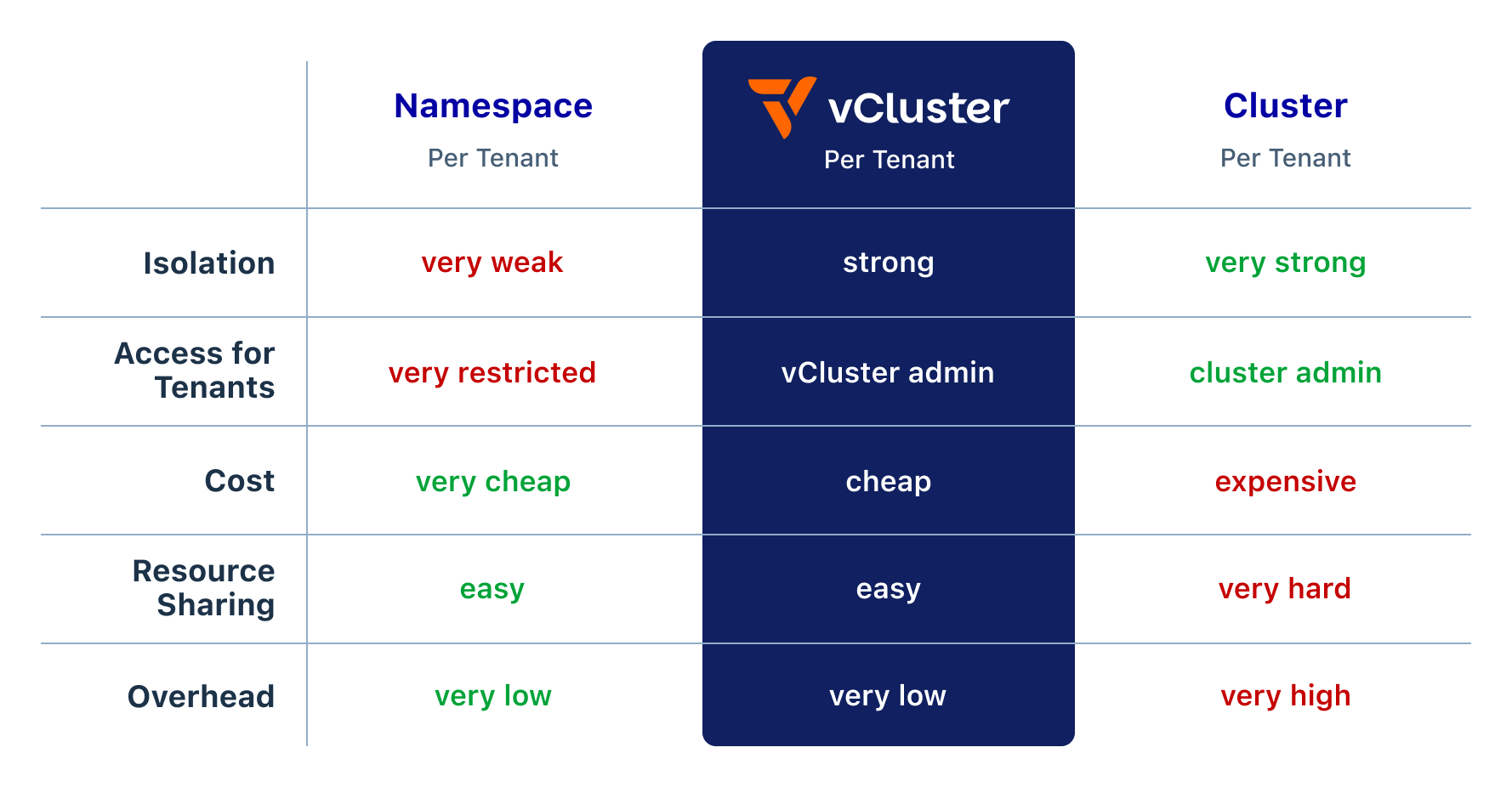
Robust security and isolation
- Granular permissions: vClustervClusterAn open-source software product that creates and manages tenant clusters within Kubernetes infrastructure. vCluster provides tenant isolation capabilities while reducing infrastructure costs. users operate with minimized permissions in the host cluster
- Isolated control plane: Each virtual cluster comes with its own dedicated API server and control plane, creating a strong isolation boundary.
- Customizable security policies: Tenants can implement additional virtual cluster-specific governance, including OPA policies, network policies, resource quotas, limit ranges, and admission control, in addition to the existing policies and security measures in the underlying physical host cluster.
- Enhanced data protection: With options for separate backing stores, including embedded SQLite, etcd, or external databases, virtual clusters allow for isolated data management, reducing the risk of data leakage between tenants.
Access for tenants
- Full admin access per tenant: Tenants can freely deploy CRDs, create namespaces, taint and label nodes, and manage cluster-scoped resources typically restricted in standard Kubernetes namespaces.
- Isolated yet integrated networking: While ensuring automatic isolation (for example, pods in different virtual clusters cannot communicate by default), vCluster allows for configurable network policies and service sharing, supporting both separation and sharing as needed.
- Node management: Assign static nodes to specific virtual clusters or share node pools among multiple virtual clusters, providing flexibility in resource allocation.
Cost-effectiveness and reduced overhead
- Lightweight infrastructure: Virtual clusters are significantly more lightweight than physical clusters and can spin up in seconds, contrasting sharply with the lengthy provisioning times often seen in environments like EKS (~45 minutes).
- Resource efficiency: By sharing the underlying host cluster's resources, virtual clusters minimize the need for additional physical infrastructure, reducing costs and environmental impact.
- Simplified management: The vCluster control plane, running inside a single pod along with optional integrated CoreDNS, minimizes operational overhead, making virtual clusters especially suitable for large-scale deployments and tenant isolation scenarios.
Enhanced flexibility and compatibility
- Diverse Kubernetes environments: vCluster supports different Kubernetes versions, allowing version skews. This makes it possible to tailor each tenant cluster to specific requirements without impacting others.
- Adaptable backing stores: Choose from a range of data stores, from lightweight (SQLite) to enterprise-grade options (embedded etcd, external data stores like Global RDS), catering to various scalability and durability needs.
- Runs anywhere: Virtual clusters can run on EKS, GKE, AKS, OpenShift, RKE, K3s, cloud, edge, and on-prem. As long as it's a Kubernetes cluster, you can run a virtual cluster on top of it.
Improved scalability
- Reduced API server load: Virtual clusters, each with their own dedicated API server, significantly reduce the operational load on the host cluster's Kubernetes API server by isolating and handling requests internally.
- Conflict-free CRD management: Independent management of CRDs within each virtual cluster eliminates the potential for CRD conflicts and version discrepancies, ensuring smoother operations and easier scaling as the user base expands.
Common use cases
Pre-production
- Empower developers with self-service Kubernetes: Simplify Kubernetes access for developers through self-service virtual clusters, reducing human error and enhancing developer autonomy without compromising security and compliance requirements.
- Accelerate CI/CD with ephemeral Kubernetes clusters: Instantly create clean, new virtual Kubernetes clusters for each pull request, enabling fast, isolated testing and PR previews without wait times and the struggles of a shared test environment.
Production
- Elevate your ISV offering with a dedicated cluster per customer: Host each customer in a virtual cluster with strict tenant isolation and seamless scalability while consolidating essential tools into a unified platform stack serving multiple tenants.
- Build a managed Kubernetes service with best-in-class COGS and high margins: Enable direct customer access to dedicated virtual Kubernetes clusters, streamlining node and resource allocation for industry-leading efficiency and unparalleled scalability.